

Auscultation of pavements
Structural and Functional Evaluation of Pavements
Maximise the useful life of your infrastructures by accurately assessing load-bearing capacity and ride quality.
SOCOTEC has advanced deflectometry and profilometry technology to accurately assess the structural and functional condition of pavements. An essential service for road and airport construction, maintenance.
What is pavement auscultation?
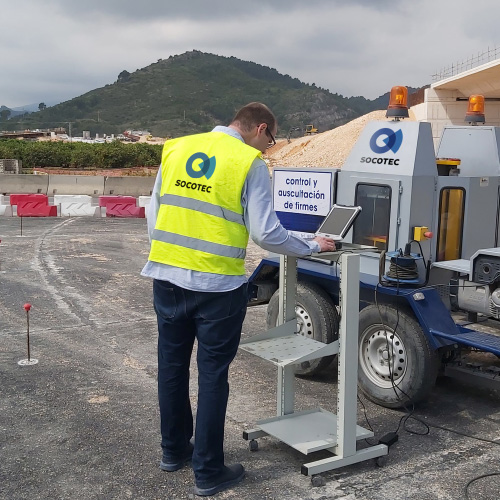
Pavement auscultation is a set of non-destructive techniques that allow the structural and functional state of a pavement to be evaluated without the need to extract samples or damage the infrastructure. Specialized equipment is used to measure:
- Bearing capacity: Structural resistance of the pavement to traffic loads
- Level of deterioration: Identification of weakened areas and internal degradation of layers
- Ride quality: Driving comfort and surface regularity
This comprehensive assessment makes it possible to distinguish between functional problems (roughness, surface deformations) and structural problems (loss of bearing capacity), optimising conservation and rehabilitation decisions.

Talk to our experts


KEY DIFFERENCE:
Structural Auscultation vs. Functional Auscultation
- Structural auscultation (Deflectometry): Evaluates the bearing capacity of the pavement by measuring deformations under load, allowing estimating modulus of the layers and calculating the necessary reinforcements.
- Functional auscultation (IRI): Quantifies surface quality and circulation comfort through the longitudinal profile, being key to planning conservation actions.
The combination of both techniques provides a complete view of the condition of the pavement.
Why perform your auscultation with SOCOTEC

State-of-the-art equipment
FWD/HWD, LWD PRIMA 100, LaserProf and Walking Profiler G3

Multidisciplinary team
specialized in flooring, reverse calculation techniques and management systems

Experience in multiple infrastructures
Roads, highways, airports, railway platforms, urban works

Advanced analysis capability
Structural modelling, standard-compliant reinforcements, integration with BIM

Specialized Airport Technology
HWD Configuration and Joint Load Transfer (LTE) Testing

Complete consulting
From auscultation to the design of rehabilitation solutions
Where is pavement auscultation necessary?
Application contexts:
- Roads and highways: Rehabilitation studies, network management, post-reinforcement evaluation
- Airports: Runways, taxiways, aprons (flexible and rigid pavements)
- Quality control: Reception of new works, verification of layer compaction
- Concessions: Monitoring of the state of the road surface during the concession period
- Recycling Projects: Pre- and Post-Intervention Evaluation
- Railway works: Control of platforms, form layers, siding tracks
Recommendation: Periodic auscultation for preventive management of networks and specific studies for rehabilitation projects or change of traffic demands.
Structural Auscultation by Deflectometry
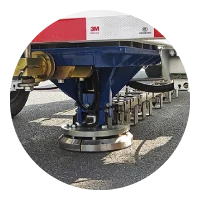
Heavy Impact Deflectometer (FWD/HWD)
International reference equipment mounted on trailers that applies impact loads equivalent to those of real traffic (50-120 kN). It measures the deformation of the pavement by means of 9-11 radially distributed geophones, obtaining the "defle
HWD modular configuration: Our equipment incorporates additional masses to operate as Heavy Weight Deflectometer in airports, reaching representative load levels of large tonnage aircraft.
Information obtained:
- Elastic layer modules using backcalculation
- Effective structural thickness
- Residual pavement life
- Dimensioning of optimized structural reinforcements
- Detection of weak areas and loss of support
Specialized Applications:
On roads:
- Rehabilitation studies according to regulations (e.g. CV Pavement Section Standard)
- Road network management
- Post-recycling evaluation or reinforcement
- Reinforcement design using multilayer models
At airports:
- Assessment of load-bearing capacity for new aircraft
- Load Transfer Efficiency (LTE) tests: Special configuration where the load is applied next to a joint on rigid pavement and sensors simultaneously measure both slabs, identifying deficiencies in pins, corrosion or loss of support
- Reinforcement design for extended service life
- Analysis of flexible and rigid pavements
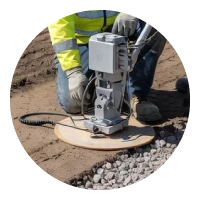
Light Impact Deflectometer (LWD) PRIMA 100
Portable equipment for rapid assessment of bearing capacity of esplanades, granular layers and stabilised soils. It applies load by means of a mass drop of 10 kg on a 300 mm plate, calculating the dynamic modulus of deformation.
Ventaja diferencial frente a placa de carga estática: No requiere camión de reacción ni equipos pesados, permitiendo trabajar en emplazamientos inaccesibles:
- Railway platforms and form layers
- Tunnels with clearance restrictions
- Narrow Width Embankments
- Trenches and service fills
- Urban works with limited access
- Airport construction phases without heavy vehicle access
Limitations: Reduced depth of influence. It does not replace the FWD for structural studies of pavements in service.
Productivity: Very fast tests (< 1 minute/point) → High control density and complete representation of layer homogeneity.
Main applications:
- Compaction control of concourses and granular layers
- Railway works: high-speed lines, logistics terminals, maintenance with reduced windows
- Reception of foundation layers
- Stabilized Soil Assessment
- Quality control during construction
Limitations: Reduced depth of influence. It does not replace the FWD for structural studies of pavements in service.
Auscultación Funcional: Medición del IRI
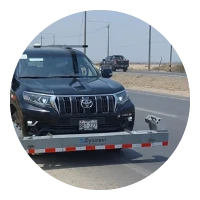
LaserProf High Speed Inertial Profilometer
Laser system + accelerometer + odometry that reconstructs the real longitudinal profile driving at traffic speed. Automatically calculates the IRI using the standard "Quarter Car" model.
Advantages:
- High productivity: Thousands of kilometers evaluable in network campaigns
- Safety: No traffic cuts or personnel exposure
- Continuous auscultation: Data every few meters
Main applications:
- Regional and state networks
- Road concessions
- Pavement inventories
- Reception of extensive works
- Airports: Complete runway and taxiway campaigns
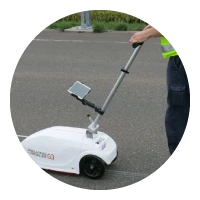
Walking Profiler G3 (Reference Team)
Maximum precision manual profilometer operated at walking speed. Internationally regarded as a World Bank Class 1 reference equipment for verification and calibration of high-speed profilometers.
Advantages:
- Maximum accuracy and repeatability: Very low uncertainty
- International reference: Validation of other equipment
- Versatility: No vehicle required, ideal for unique areas
Main applications:
- Calibration of Inertial Profilometers
- Receiving wearing courses (quality control)
- Airports: runway thresholds, landing zones, joints
- Detailed checks for specific sections
- Experimental studies and calibration sections
Comparación: LaserProf vs. Walking Profiler G3
LaserProf | Walking Profiler G3 |
|---|---|
Alta velocidad (tráfico normal) Productividad Muy alta Precisión Alta Excelentes redes extensas | Velocidad de caminata Productividad Baja-media Precisión Muy alta (referencia) Redes extensas limitadas |
Our methodology
Applicable regulations and standards
- Standard for Pavement Sections of the Valencian Community: Includes structural characterisation by means of deflectometry and use of modules by inverse calculation
- Standard 6.3-IC "Rehabilitation of pavements": Structural evaluation criteria
- Junta de Andalucía. Ministry of Public Works and Transport. Instruction for the design of pavements of the Andalusian Road Network. ICAFIR, based on mechanistic calculation using modules obtained by FWD.
- NLT-330: IRI
- UNE 103807-2: LWD
- UNE 41250-3 : FWD
- ASTM D4694, ASTM D4695 & AASTHO: LTE
- MITMA/CEDEX Technical Notes
Discover the real condition of the floors
Optimize your conservation investments through accurate technical assessment. Request your auscultation proposal without obligation.
Frequently Asked Questions (FAQs)

Talk to our experts