
Water in a world in transition: the new SOCOTEC White Paper
Discover the new SOCOTEC White Paper on water management: water risk, PFAS, water security and strategies for buildings, infrastructures and industry.
Public bodies, companies and operators in the real estate and infrastructure sector: the challenges related to water management are evolving rapidly and are redefining the operational conditions of territories, buildings and strategic assets.
With the increase in extreme weather events and the pressure on water resources, water management is assuming an increasingly central role for territories, infrastructures and industrial activities. Today, rethinking the way water is managed means facing one of the main challenges of the future.
How to anticipate the risks related to water scarcity, extreme weather events and regulatory evolution? What strategies should we adopt to make buildings, infrastructure, and industrial sites more resilient, efficient, and sustainable in the long term?

Talk to our experts


NEW SOCOTEC WHITE PAPER
"Water in a World in Transition"
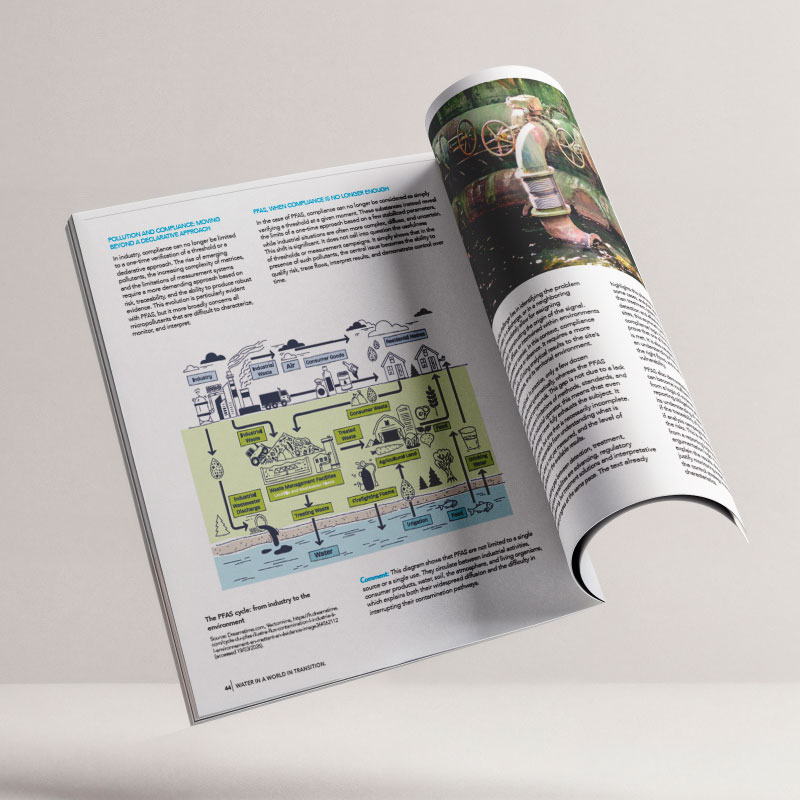
With the new White Paper "Water in a World in Transition", SOCOTEC offers a concrete and multidisciplinary vision of the main challenges related to water management, through analyses, technical in-depth and operational solutions dedicated to the construction, real estate, infrastructure and industrial sectors.
The document delves into key topics such as:
- Climate change and impacts on water resources
- Hydraulic risk management and extreme events
- Water Quality, PFAS, and New Regulatory Challenges
- Reduced water consumption and efficiency
- Monitoring, data and digital tools
- Water reuse and infrastructure resilience
- Operational continuity and sustainable asset performance
The White Paper brings together international knowledge, analysis and experiences to support companies and territories in addressing the challenges of the water transition.
With the new White Paper "Water in a World in Transition", SOCOTEC offers a concrete and multidisciplinary vision of the main challenges related to water management, through analyses, technical in-depth and operational solutions dedicated to the construction, real estate, infrastructure and industrial sectors.
The document delves into key topics such as:
- Climate change and impacts on water resources
- Hydraulic risk management and extreme events
- Water Quality, PFAS, and New Regulatory Challenges
- Reduced water consumption and efficiency
- Monitoring, data and digital tools
- Water reuse and infrastructure resilience
- Operational continuity and sustainable asset performance
The White Paper brings together international knowledge, analysis and experiences to support companies and territories in addressing the challenges of the water transition.
When water puts pressure on the active ingredients
Port and river infrastructures, dikes, dams, networks, treatment plants and energy facilities have a direct relationship with water, whether for its collection, channelling, storage, discharge or protection against it.
Today, this relationship is increasingly demanding. Climate change increases hydrological variability, intensifies certain extreme phenomena and generates greater uncertainty in the conditions under which infrastructures must be designed, operated and adapted. Water can no longer be considered a mere contextual factor. It has become a structural parameter for the sustainability of assets, the security of territories and the proper functioning of essential services.
"Dams, dikes, canals and crossing structures constitute the main framework for flood protection and water resources management."
Bridges, docks, ports, dikes, dams, and coastal or containment structures are subject to water-related stresses that can affect their stability, durability, and, in some cases, safety.
Water acts on structures through multiple mechanisms. It infiltrates, erodes, undermines, weakens soils, accelerates corrosion and subjects materials to repeated stresses. Some phenomena are slow and progressive, while others occur more abruptly, such as during floods, submersions or intense episodes of runoff.
Individually, these mechanisms are not new. What has changed today is its intensity, frequency and combination, in a context marked by rising sea levels, greater variability in flows and the increase in extreme events. You can find detailed information on these topics, and many other water-related issues, in the ebook below.
Contribution of international experts

Carlos Hermosilla
Head of the Hydraulic and Hydroelectric Civil Engineering Area, SOCOTEC Spain

Pascual Abad Moreno
Civil Engineering Solutions, SOCOTEC Spain

Delphine Villard
Managing Director BU Equipment, Industry and Infrastructure, SOCOTEC France

Isabell Holling
Managing Director of Monitoring and Surveying, SOCOTEC UK

Grace Williams
Commercial Director of Water Equipment, SOCOTEC UK

Rob Buitendijk
Commercial Director, SOCOTEC Building Performance, SOCOTEC The Netherlands

Loic Bourdon
Head of Maritime, River and Water Activities, SOCOTEC Infrastructure

Patrick Buquet
BWD Manager, Territorial Planning and Water/Flood Referent, SOCOTEC

Yannick Leblanc
Pollution Expert, SOCOTEC Environment France

Celine Pignot
Head of Industrial Risk Activity | ICPE, SOCOTEC Environnement

Frédéric Motta
- Development Director, SOCOTEC Immobilier Durable France
Do you need a reliable partner for water management?
Contact our experts and find out how we can help you transform water into a factor of resilience, continuity and competitiveness for your organisation.