Need advice?
Send us your details and we will contact you
Contact us

With a historic endowment of 7,000 million euros, it is the first plan developed under the Housing Law, which recognises access to housing as a constitutional right and not as a simple market good.
The Government proposes a State Agreement based on three pillars: tripling public investment, guaranteeing the permanent protection of the social housing stock and improving the transparency of the real estate market. This approach seeks the collaboration of all the competent administrations and requires efficient and specialized engineering capable of materializing these ambitious objectives in short deadlines and with higher quality standards.

40% of the budget (2,800 million euros) is allocated to increasing the stock of affordable housing with permanent protection, doubling the investment of the Next Generation EU funds. Aid for the construction of Social Housing (VPO), previously suppressed, is recovered, but with a fundamental novelty: these homes will maintain their permanent protection, avoiding their disqualification and sale on the free market.
The new State Housing Plan is structured through an innovative public-private collaboration that incorporates social promoters as key actors, prioritising stressed areas and advanced construction technologies to optimise deadlines and mobilise the stock of empty housing.
PARES Program
La Región de Murcia ha ampliado el Programa PARES (Programa de Acceso a Recursos de Emergencia Social), orientado específicamente a familias en situación de exclusión social. Este programa no solo facilita la adquisición de nuevas viviendas, sino que incorpora un acompañamiento social integral para garantizar la integración efectiva de las familias beneficiarias.
La inversión ampliada permitirá:
Rehabitare Program
The Regional Government of Castilla y León has developed the Rehabitare Programme, an innovative initiative that simultaneously addresses two critical problems:
The programme rehabilitates these underused homes to convert them into public social rental housing, prioritising rural areas and thus contributing to:
Urban Incentives
The Regional Government of Andalusia has approved a package of urban planning measures that facilitate the development of social housing through:
These measures seek to eliminate urban barriers that have historically hindered the construction of social housing in the autonomous community.
Pla Viure Barcelona
Barcelona City Council considers access to housing as one of its main lines of action. For this reason, it has promoted the Pla Viure, a new strategic line of mandate for the period 2025-2032.
Characteristics of the Pla Viure:
The Pla Viure was created within the current legal framework, taking into account the economic and social changes in Barcelona, with the aim of guaranteeing the right to housing for all citizens.
Housing Industrialisation Strategy
The Basque Government's Department of Housing and Urban Agenda has decisively promoted the industrialisation of construction as the central axis of its housing policy. This strategy is conceived as a "forced transition" and structural to:
Objectives of the Social Pact for Housing for 2036:
Industrialisation becomes the "third leg" of the Basque strategy, together with regulation and direct aid, consolidating a construction of the future that prioritises quality, speed and sustainability.
Plan VIVE
The VIVE Plan is one of the most outstanding commitments of the Government of the Community of Madrid to increase the supply of housing in the region, making public land owned by the Administration available to the market through public-private collaboration.
Achievements of the VIVE Plan:
SOCOTEC's Role in the VIVE Plan:
SOCOTEC has been a technical reviewer of various projects of the VIVE Plan, contributing its experience in:
More information on SOCOTEC's participation in the VIVE Plan
For industrialized construction to be viable and efficient, it is essential to have specialized structural engineers capable of designing, calculating, reviewing and coordinating these complex systems. Its work covers many fundamental technical aspects.
They must develop structural systems that integrate prefabricated elements safely and efficiently, eliminating pillars in homes where possible to maximize usable space and distribution flexibility. These systems must be modular, allowing them to be adapted to different architectural typologies without losing efficiency. The role of engineering is to review the needs of architects, construction companies, manufacturers of industrialized systems, installers and control bodies, ensuring that all disciplines work in an integrated way and the result is optimal.
The implementation of BIM (Building Information Modeling) methodologies is essential in this process, as it allows interference to be detected before the construction phase, optimising the design and facilitating coordination between all agents. Engineers must also ensure that projects comply with all current regulations on structural safety, energy efficiency and accessibility, an increasingly complex aspect given the constant evolution of the regulatory framework.
Today's engineering must integrate sustainability criteria throughout the building's life cycle: energy efficiency, minimisation of the carbon footprint, sustainable materials and renewable energies from the design. This vision not only meets regulatory requirements, but also reduces the costs of use, making homes truly affordable in the long term.
Construction evolves towards Construction 4.0, incorporating digitalisation, automation and prefabrication. Engineers are protagonists of this transformation, providing the essential technical knowledge to execute the homes of the State Plan. Without effective engineering, capable of offering fast, economical and quality solutions, the right to housing would remain a mere declaration of intent.
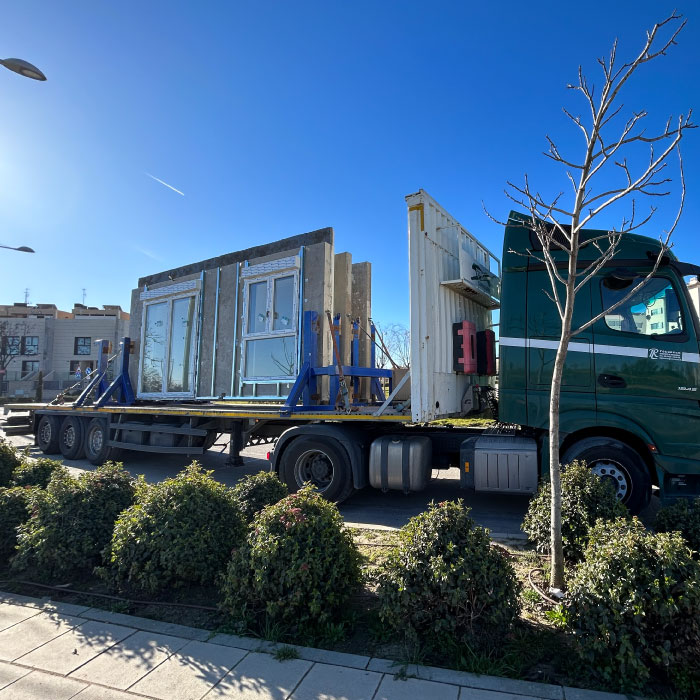
Industrialised construction – which consists of manufacturing a large part of the components of a building in a controlled industrial environment and then assembling them on site – is establishing itself as the most effective technical solution to meet the challenge of affordable housing.
This system allows execution times to be reduced by 30% to 60% compared to traditional construction, which is crucial when it is necessary to make homes available to families who need them urgently.
Factory work guarantees much higher quality control than is possible on site, where climatic and logistical conditions are more variable. The standardisation of processes significantly reduces waste and allows for better management of resources, contributing to the sustainability of the sector. In addition, factory work improves working conditions, increases safety and is more attractive to new generations of professionals, including technical and engineering profiles and also women, which favours the necessary renewal of the sector.
Industrialised construction – which consists of manufacturing a large part of the components of a building in a controlled industrial environment and then assembling them on site – is establishing itself as the most effective technical solution to meet the challenge of affordable housing.
This system allows execution times to be reduced by 30% to 60% compared to traditional construction, which is crucial when it is necessary to make homes available to families who need them urgently.
Factory work guarantees much higher quality control than is possible on site, where climatic and logistical conditions are more variable. The standardisation of processes significantly reduces waste and allows for better management of resources, contributing to the sustainability of the sector. In addition, factory work improves working conditions, increases safety and is more attractive to new generations of professionals, including technical and engineering profiles and also women, which favours the necessary renewal of the sector.

The current plan has laid the foundations for collaboration between administrations, establishing:
European funds have made it possible to:
These funds have generated a "rehabilitation wave" that the 2026-2030 State Plan seeks to consolidate and expand.
At SOCOTEC we are committed to the development of industrialised social housing as an effective response to the challenge of access to housing in Spain.
Our experts develop new methods of planning and construction with industrialization to address the housing problem, providing:
Specialized Structural Engineering
Multidisciplinary Coordination
Reference Projects
At SOCOTEC we understand that industrialisation is not only a construction technique, but also a fundamental tool for:
Our technical capacity and experience in industrialised construction position us as a strategic partner of public administrations, developers and construction companies in the development of the ambitious State Housing Plan 2026-2030.
The State Housing Plan 2026-2030 represents a historic commitment to the right to housing in Spain. Its success will depend on effective collaboration between all administrations, the commitment of private agents and, fundamentally, on the technical capacity of engineering to materialize thousands of homes in short deadlines, with superior quality and sustainability criteria.
Regional programmes complement and adapt this strategy to territorial realities, while industrialised construction emerges as the technical solution that makes these ambitious objectives viable.
Do you need us to accompany you in your home construction project?
SOCOTEC, with its experience and commitment, continues to be a key player in this transformation of the sector towards a model that prioritises universal access to decent and affordable housing.